We got some new cars and a new car mat in our classroom. We love playing with them. Today we decided to try out some science and maths activities with them. Teacher made a ramp. We had to guess how far the car would travel when it came off the end of the ramp. Then we measured the distance it travelled using lollipop sticks. First of all we tried it from the ramp onto the floor. This distance measured 17 lollipop sticks.

 Next we tried the car mat. The car came speeding down the ramp, but slowed down when it came to the car mat. We guessed that the fluff on the surface of the mat slows down the wheels of the car. This is because of a force called friction between the wheels and the mat. The car only travelled 4 lollipop sticks on this surface.
 We tried our jigsaw mats next. On the smooth side the car travelled 3 lollipop sticks, and on the rough side the car travelled 3 and 1/2 lollipop sticks before it stopped. We found this result a little surprising but we think that the car bounces over the rough side easier than the smooth side (less friction).
 The last time we tried the car it was on a rug. The car didn't travel far on this rug at all. It went only 2 and 1/2 lollipop sticks. This is because the rug was very soft and it slowed the car down a lot.
 We were careful to make this a fair test. The ramp stayed the same all the time and the car was not given any push to start. Each time we measured the distance we did it from the bottom of the ramp to where the car stopped. We loved this investigation, and we can't wait to try it at home ourselves.
 We each got a black sheet of paper, onto which we wrote our names, cut out felt pieces to make a rocket, used coloured wool for the fire blasting out of the rocket, then used potato prints to add stars, moons and planets to our pictures. We would love to be blasting off to space in the rockets we made.
 We have a hairdryer that teacher brought to school today. We know that when it is turned on that air rises from it. We got different kinds of balls and put them in the air stream to see whether they would float on the air stream or not. Here is what we discovered:The ping pong ball is light and filled with air. It floated nicely on the air stream.
 In fact, sometimes we could get two ping pong balls to float together in the air. The bouncy ball is made of rubber, filled with rubber, and heavier than the ping pong ball. It doesn't float at all. The styrofoam (polystyrene) ball is the lightest of all, filled with styrofoam, if floats really high up for a second, then jumps out of the air stream.
 It needs to be a little heavier for gravity to work on it and pull it back into the air stream every time it floats too high. We love this investigation because we can try it easily at home.

 We made a square, cube, rectangle, cuboid, triangle, triangular prism, a pentagon and a hexagon. It wasn't possible to make a cylinder or sphere. We could see that the shapes made using triangles were the strongest - that's why you see so many triangle shapes in bridges and cranes. Next we made our own 3D shapes: with 3D jigsaw pieces,


 beads and connectors, flat triangles and squares,


 flat window shapes
 and with magnetic pieces.
 Each group had a different activity, and we will swop around for the rest of the week. We managed to make squares, triangles, rectangles, cubes, cuboids, a pentagonal prism, triangular prisms, a diamond,triangular pyramids and square pyramids. We really are good at making and naming shapes.

 All of these things are acids.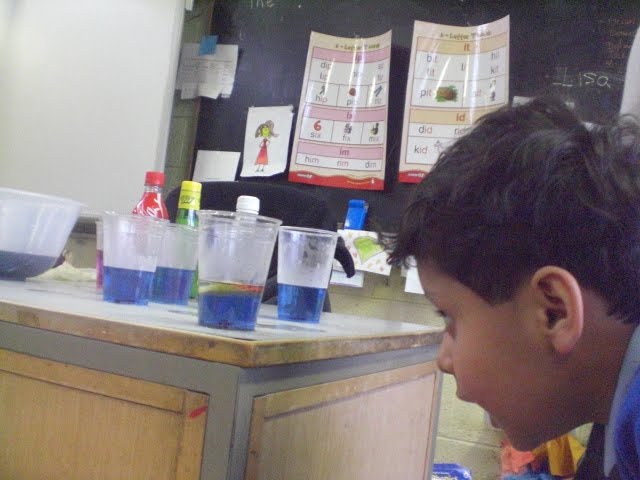
 The jelly sweet we used didn't turn the water a different colour at all. When we tried bread soda the water turned a greeny blue.
 At the end of all the testing we mixed an acid (vinegar) with a base (bread soda) and the colour went back to the colour it was at the start (pH neutral). We loved all the colours, and we know now that we should wash our teeth after drinking (and eating) foods with acids in them.
 She added them to a container that was about one third full of water. The tablets dissolved and made a gas (CO2). This gas then pushed (exploded) the top of the container off. We put the top on again and the rocket exploded again and again and again.

 It really looked like a rocket, but was a bit more messy than the other way round. We know that real rockets are fueled with burning gas. Gas is great for making rockets fly!


 We are talking all about whether materials are waterproof or absorbent. We carried out some investigations to see which were absorbent and which were waterproof.


